
The Gold Standard of Silk: A Journey Into the History and Threads of Au Ver à Soie
When you slip a strand of pure silk thread through a piece of antique linen, you aren't just stitching; you are participating in a lineage of craftsmanship that has survived revolutions, industrial shifts, and the passage of centuries.
In the world of fine needlework, one name stands as the undisputed sovereign of this medium: Au Ver à Soie (literally, "To the Silkworm").
Today, we are pulling back the curtain on this legendary Parisian house—exploring its rich tapestry of history and breaking down their world-renowned thread families so you can select the perfect luster for your next slow-crafted masterpiece.🏛️
A Legacy Woven in Paris: The History of Au Ver à Soie
The story of Au Ver à Soie begins in Paris in 1820, established by the Marcassus family. For over two centuries, this family-owned dynasty has guarded the secrets of selecting, dyeing, and spinning the highest quality silk filaments in the world.
During the Golden Age of Haute Couture in the 19th and 20th centuries, Au Ver à Soie became the primary supplier of silk thread to the legendary fashion houses of Paris—including Chanel, Dior, and Lanvin. If a breathtaking silk gown graced a Parisian runway, it was almost certainly held together by the invisible strength and visible lustre of Au Ver à Soie.
Today, under the passionate leadership of the family's newer generations, the house remains tucked away in its historic Paris atelier. They continue to collaborate with state institutions, historical preservationists, and haute couture studios, ensuring that museum-grade textile restoration and modern textile art remain anchored to the highest standards of French excellence.🧵
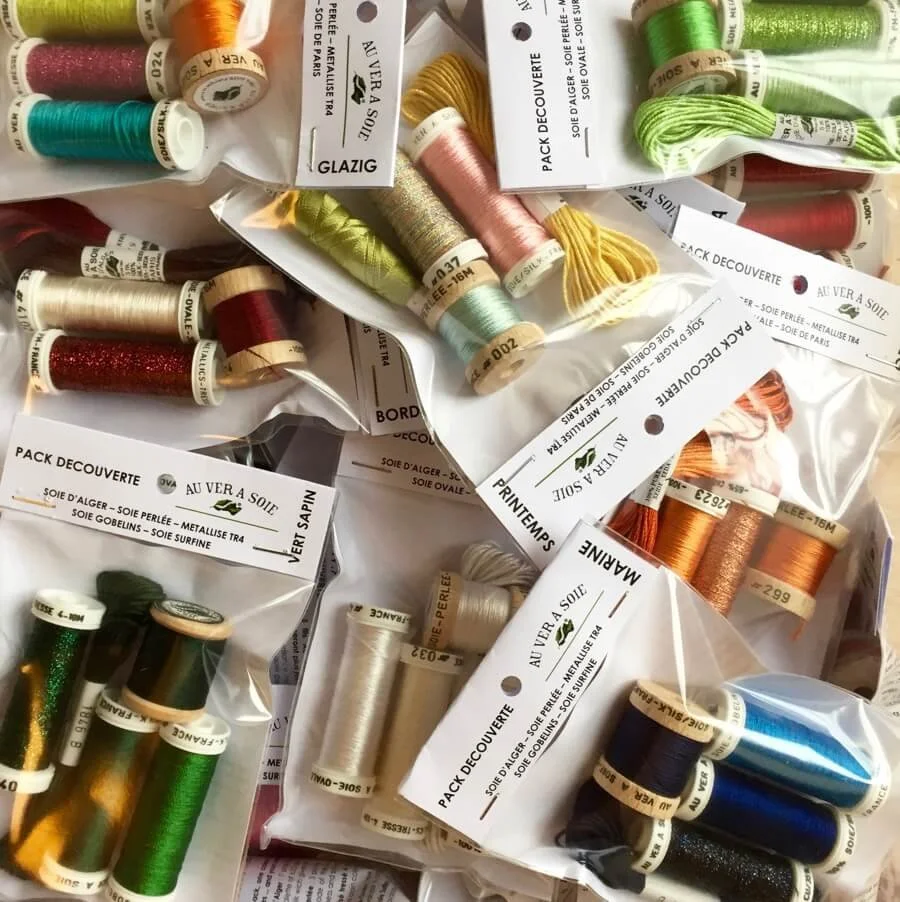
The Master Palette: A Guide to Au Ver à Soie Products
To the uninitiated, silk is simply silk. But to a master embroiderer, the way a thread is spun, plied, and finished dictates exactly how it will catch the light and sit on the fabric canvas.
Here is a comprehensive guide to the signature thread families produced by Au Ver à Soie, and how to use them in your own practice:
1. Soie d'Alger (Spun Silk)
The Character: Despite its historic name referencing Algerian trade routes, this is a premium, 7-ply spun silk made from the finest schappe silk fibres.
The Finish: It possesses a soft, semi-matte, deeply elegant luster. It is incredibly smooth to work with and does not split or pill easily.
Best For: Historically accurate cross stitch, sampler reproduction, needlepoint, and fine crewelwork. The 7 plies can be easily split apart, allowing you to control the exact thickness of your stitches on high-count linens.
2. Soie 100/3 (Fine Embroidery Silk)
The Character: A highly specialized, twisted 3-ply silk that is exceptionally fine and remarkably strong.
Best For: Fine linen embroidery, miniature needlework, machine embroidery, and microscopic stitching. Because of its strength, it is also the darling of historical reproductionists working on 40-count (and higher) linens.
3. Soie Perlée (Twisted Silk Pearl)
The Character: A beautiful, tightly twisted 3-ply corded silk. It is the silk equivalent of a pearl cotton.
The Finish: High-luster, intense shine, and a distinct, raised textural presence on the fabric.
Best For: Hardanger embroidery, buttonhole stitching, crazy quilting, blackwork, and decorative sashiko-style accents. It sits proudly on top of the fabric, creating dramatic, light-catching geometric lines.
4. Soie Gobelins (Filament Silk)
The Character: A high-end, highly twisted 2-ply filament silk thread.
The Finish: Smooth, crisp, and slightly wire-like in its precision.
Best For: Fine tapestry work, weaving, and delicate canvas work. It is named after the historic Gobelins Tapestry Manufactory in Paris, reflecting its incredible pedigree in structural textile art.
5. Soie Surfine (The Fine Sewing Silk)
The Character: An incredibly delicate, fine 2-ply silk thread.
The Finish: Practically invisible once stitched, leaving only a whisper of organic colour.
Best For: Invisible appliqué, fine lace-making, and attaching delicate glass beads or sequins to silk backing without bulky knots or heavy thread shadows.💎
6. Ruban de Soie (Pure Silk Ribbon)
The Character: A breathtakingly soft, woven ribbon crafted from 100% natural mulberry silk, available in delicate widths ranging from microscopic 2mm and 4mm up to dimensional 7mm and 13mm. To make designing effortless, each ribbon colorway is matched perfectly to the legendary Soie d’Alger dye palette.
The Finish: A fluid, luminous, and incredibly tactile drape. Because it is woven from pure silk, it glides through fabric smoothly without splitting, snagging, or puckering.
Best For: Exquisite silk ribbon embroidery, crazy quilting, dimensional stumpwork, and heirloom baby garments. It is the ultimate tool for creating highly realistic, three-dimensional botanical elements like soft rosebuds and delicate foliage.
Why We Curate Au Ver à Soie
As an atelier dedicated to the preservation of slow, human-authored craft, we do not compromise on materials. We believe that the hours you spend breathing life into a piece of fabric deserve to be matched by fibers that will endure for generations. AuVer à Soie threads do not fade, they do not tire, and their colours hold a rich depth that modern synthetic threads simply cannot mimic. They are a literal bridge to the history of haute couture and royal preservation.
🌐 Where to Experience & Acquire
We do not sell these threads directly in our shop; instead, we proudly point our community of makers to the most trusted, independent boutique retailers who stock authentic Au Ver à Soie collections:
In Europe & Worldwide: To explore their complete, breathtaking colour catalog directly, visit the official Au Ver à Soie Atelier in Paris.
For Independent Curators: Check with your local, independent heritage needlework shops, which frequently stock curated Soie d'Alger assortments in hand-dyed palettes. Also check the Online Resellers page on the main Au Ver a Soie site.
